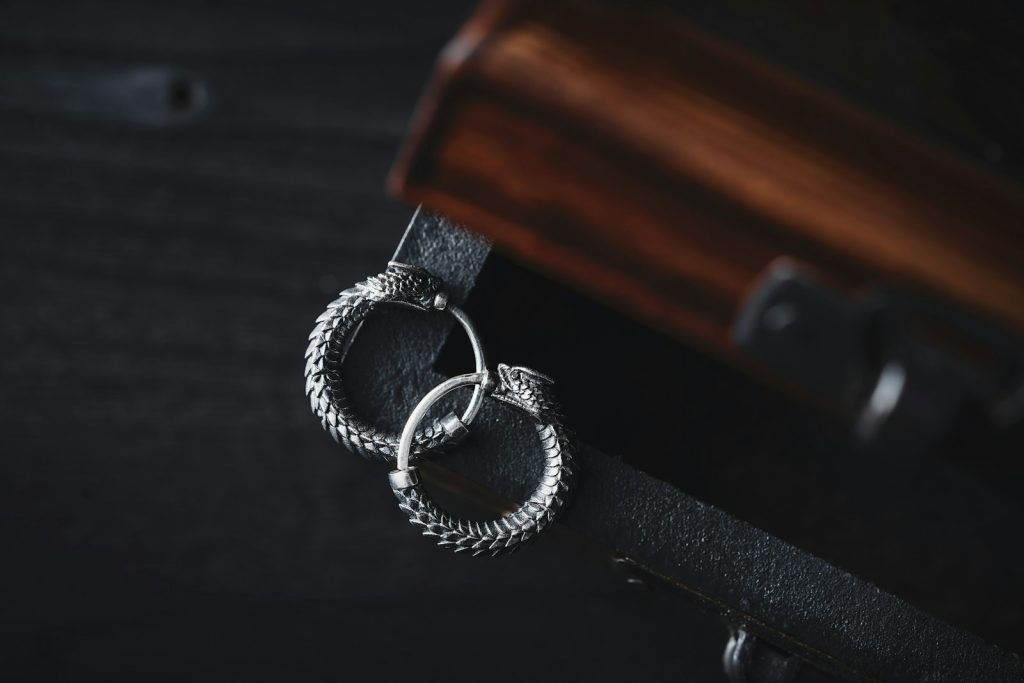
Oxidized silver jewelry wholesale means buying 925 pieces that are intentionally darkened, not defective or tarnished, and finished that way at scale for resale. In Bali, this blackened 925 look is a deliberate part of the design and a major segment of Celuk’s export-ready catalog.
What Is Oxidized 925 Silver in the Balinese Context?
Oxidized 925 silver is standard sterling silver (92.5% silver, 7.5% alloy) whose surface has been darkened by a controlled chemical or heat process. In Celuk, artisans use that dark layer to highlight Balinese filigree, granulation, and motif work.
Key points for buyers:
– Base metal is still 925 sterling; only the surface color changes.
– The dark layer is very thin and lives mostly in recesses and textures.
– Intentional oxidation is a finish, not a QC failure and not “dirty” stock.
Balinese blackened silver jewelry typically shows:
– High contrast between recessed black areas and bright-polished highlights.
– Deep shadows inside curls of filigree, dots of granulation, and border relief.
– A more “antiqued” or ethnic presentation versus rhodium-bright mainstream silver.
If you are sourcing antiqued silver wholesale from Bali, most of what you see on classic Balinese cuffs, rings, and beads is not natural tarnish but planned oxidation locked in at the workshop.
Sterling Mechanics: What Does “925” Still Mean Once It’s Black?
“Sterling” and “925” refer to alloy content, not color. For your compliance team and customs paperwork, the oxidation step does not change:
– HS code classification as silver jewelry (typically 7113.11 / 7113.20; verify for your market).
– Precious metal content declarations (92.5% silver).
– Country of origin (Bali/Indonesia, assuming production is done here).
You are still buying:
– Solid 925 silver, often stamped “925” or “STERLING”.
– With an additional surface treatment (oxidation) that may be noted on line-sheets or packing lists for clarity.
For OEM and private-label, we can align hallmarks to your destination rules where allowed (e.g., 925 + country code, your brand mark, etc.). You should confirm hallmarking regulations with your local assay or customs authority before placing production POs.
How Balinese Oxidized Silver Is Actually Made
Oxidation is usually the last or second-last step in the finishing line. In Celuk, common workflows look like this:
1. Fabrication of the 925 Base
– Casting, wire drawing and sheet work.
– Application of Balinese filigree (fine twisted wires) and granulation (tiny silver balls).
– Soldering, forming, basic clean-up and pre-polish.
At this stage, pieces are bright-silver, sometimes with light fire-scale.
2. Oxidizing (Blackening) Stage
Workshops use different methods; two are dominant:
1. Chemical liver-of-sulfur type baths
– Pieces are dipped in a sulfur-based solution.
– Silver on the surface reacts, forming a dark silver sulfide layer.
– Time and concentration control depth of color (warm gray to almost black).
2. Commercial oxidation solutions / gels
– More standardized, better repeatability batch-to-batch.
– Often dabbed or brushed on specific zones (e.g., just the recesses).
Both are controlled processes—not random tarnishing in open air.
3. Selective Polishing to Create Contrast
After darkening, the entire piece looks almost fully black. Then:
– Bench polishers buff exposed/high areas back to bright silver.
– Recessed areas keep the blackened finish.
– Edges can be sharpened or “softened” depending on the brand’s aesthetic.
The result is high-contrast blackened silver jewelry: light on top, dark in the carving.
4. Optional Top Coats (Clear Lacquer or E-Coat)
Two realities:
– Oxidized layers can wear on high-friction points.
– Global buyers often expect slower color change out of the box.
Some exporters now add:
– Clear organic lacquer (thin, hand-sprayed or dipped).
– Anti-tarnish e-coating (electro-deposited, more even, commonly used for silver).
Those coats slow both bright silver tarnish and oxidation wear, but they also slightly change handling (e.g., slower patina development). If your brand sells on “living silver,” we can omit them; if you want lower return rates on black finish loss, we discuss topcoat options at the sampling stage.
Intentional Oxidation vs. Real Defects: What QC Should Flag
Import teams often struggle to separate:
– “It’s black = defect?”
– from
– “This piece is supposed to be antiqued silver wholesale stock.”
Below is a reference list we use in QC.
Normal for Oxidized 925
– Darkening is concentrated in recesses: between filigree, inside engraving, behind motifs.
– High spots / edges show brighter silver, sometimes with gentle gradient.
– Within a batch, tone may vary slightly piece-to-piece (hand work).
– Inside ring shanks and bracelet interiors may be lighter if not intentionally blackened.
Potentially Defective
– Patchy black “clouds” on otherwise bright, non-antiqued lines (e.g., plain mirror bangles).
– Fingerprints or swipe marks in the dark layer, visible to the naked eye.
– Uneven color inside a mirrored pair of earrings where symmetry is critical.
– Peeling, flaking, or chalky surfaces (usually a topcoat issue, not oxidation itself).
– Unknown residues or glue around stones, mistaken by some as “oxidation.”
Our QC flow separates:
– Cosmetic variation typical of handmade Balinese work (acceptable within agreed tolerance).
– Actual process errors that should be reworked or rejected.
If you’re switching from rhodium-only suppliers, we recommend approving photographic QC standards with us: front, side, macro detail, and an agreed visual range for “acceptable blackness.”
Oxidized vs Rhodium-Bright: Which Silver Finish Fits Your Channel?
Both finishes start from the same 925 base. The key differences are look, maintenance, and sometimes process cost.
| Aspect | Oxidized 925 (Blackened) | Rhodium-Bright 925 |
|---|---|---|
| Visual style | High-contrast, antique/ethnic, detailed | Mirror-bright, modern, “white gold” look |
| Main use cases | Balinese motifs, filigree, granulation, men’s, boho | Minimalist lines, bridal, mainstream fashion |
| Perceived value | Artisan craft, handmade story | Premium polish, “fine jewelry” shelf |
| Maintenance in retail | Less visible light tarnish due to dark base | Can show fingerprints/smudges; needs occasional wipe |
| Replating / reworking | Oxidation can be refreshed, but pattern must be respected | Rhodium can be stripped and replated cleanly |
| Typical buyers | Ethnic boutiques, craft-led brands, festival/boho, biker | Chain retailers, bridal, minimalist DTC brands |
| Effect of scratches | Light scratches often visually blend with dark recesses | Scratches may show as gray lines against bright surface |
We export both. Many buyers run mixed collections: oxidized Balinese centerpieces flanked by rhodium-bright basics.
If you need to decide which finish to spec for next season, request a wholesale quote to Celuk or request virtual sampling; we can review channel, target price, and care expectations over email or WhatsApp.
How Oxidation Interacts with Anti-Tarnish Coating and Rhodium
Important distinction: oxidation and rhodium are not the same process and are rarely combined on the same visible surface.
1. Oxidation + Clear E-Coat
– Oxidation is applied first, then lightly polished.
– Clear e-coating is applied over both dark and bright areas to slow further change.
– Good where you need batch consistency and lower returns for “finish changed.”
Trade-off: slight plastic-like “slip” to the touch if coating is heavy. On detailed Balinese work, we keep coats thin.
2. Rhodium Plating (No Visible Oxidation)
– A bright rhodium layer covers the silver entirely.
– Any prior oxidation is effectively hidden under rhodium.
– Used for high-gloss, low-tarnish lines (bridal, classic fine-jewelry look).
If you want micro-oxidized details inside a rhodium piece (e.g., text inlay), that must be engineered in sampling; it is not a standard off-the-line process.
3. Untreated (No Topcoat) Oxidized 925
Some buyers prefer:
– No e-coat, no lacquer, no rhodium.
– Pure silver + controlled oxidation that continues to evolve with wear.
This reads very authentic in artisan channels but requires better retail education. We can produce either way; you must decide based on your customer service capacity and return policy.
How Oxidized Silver Wears Over Time (What Your Customers Will See)
Your customer support team should know how the finish behaves:
– Recesses stay dark longest. The more texture, the longer the black shows.
– High-friction spots lighten. Ring edges, chain clasp zones, and bangle contact points may brighten first.
– Overall tone can soften. After months/years, pieces often shift from stark black/white contrast to softer charcoal/gray contrast.
Customers may describe this as:
– “Aged gracefully” (if expectations were set).
– “The black wore off” (if expectations were not set).
We recommend:
– Adding a short finish description in product copy (“oxidized 925 with intentional antiqued effect; bright areas may polish further with wear”).
– Training retail staff to distinguish cleaning from stripping.
Care Instructions for Oxidized Silver Jewelry
Provide care cards or product-page notes. For oxidized 925, instructions differ from bright silver:
What to Avoid
– No aggressive dips or silver-cleaning pastes. These can strip the dark layer quickly.
– Avoid ultrasonic cleaners on complex, oxidized filigree unless you’ve tested pieces thoroughly.
– Limit exposure to strong chemicals (bleach, chlorinated pools, strong detergents).
Recommended Care
– Wipe with a soft, dry cloth after wear (microfiber or untreated cotton).
– For light dirt, use mild soap and lukewarm water, then dry thoroughly.
– For bright areas only, a jewelry polishing cloth can be used if you keep it away from deeply darkened zones.
Customer message to promote: oxidation is part of the design. You are not trying to return the piece to full bright silver.
What Importers Should Specify up Front
Oxidized 925 is not a single standard; you control the finish through your purchase order. For wholesale, OEM, and private-label projects with Celuk Silver Wholesale, you should define:
1. Finish Description and Visual Standard
– “Moderate” vs “heavy” oxidation (stark black vs softer shadowing).
– Surfaces to be oxidized or not (front motifs only, entire piece, inside/outside ring, etc.).
– Macro photographs or master samples as QC references.
We typically hold:
– 1–2 master pieces per SKU in-house.
– Photographic standards attached to the PO.
2. Alloy and Hardness
All our oxidized silver starts from 925, but within that we can vary:
– Springiness for cuffs or rings.
– Wire vs sheet thickness to hit target gram weights.
You should specify:
– Target ring shank width and thickness in mm.
– Bracelet wall thickness where weight perception matters.
This affects perceived quality more than the oxidation itself.
3. Tolerance on Weight and Dimensions
Sterling output is handmade; we agree tolerances up front, for example:
– Gram weight: ±5–8% per piece, or a defined range by size.
– Dimensions: ±0.2–0.5 mm for most non-stone elements.
Tighter tolerances usually raise your unit cost because they increase rejection/rework rates.
4. Plating/Topcoat Stack
Be explicit:
– Oxidized + no topcoat.
– Oxidized + clear e-coat.
– Rhodium only (no visible oxidation).
If not specified, we default based on the sample you approved.
Pricing, MOQs, and Lead Times for Oxidized Silver Collections
We do not publish a fixed price list online; pricing depends on weight, complexity, labor content, and finish. The ranges below are directional (last verified June 2026) and should be confirmed by quote.
Typical FOB Price Influencers
For oxidized 925 designs out of Celuk:
– Gram weight: more metal, higher ex-factory cost.
– Labor intensity: dense filigree and granulation add hours.
– Finish steps: deep, even oxidation plus selective polish adds bench time.
– Plating / e-coat: modest incremental cost, but adds to line-time and QC.
Compared to a plain, unoxidized, non-rhodium 925 band of the same weight:
– A heavily oxidized Balinese filigree ring can be significantly more expensive due to labor, not because oxidation chemicals are costly.
MOQ Bands
Indicative MOQs we typically work with:
– Ready designs (our catalog):
– Per SKU per size: often from 30–50 pcs, subject to design.
– Mixed sizes in a single design are usually allowed within a MOQ band.
– OEM / modified designs:
– Higher MOQs, especially if new molds are needed.
– We may require development fees for new tooling.
– Full private-label lines:
– Discussed case-by-case; we align MOQs with your channel (online-only vs chain retail, etc.).
You should always request:
– A finish-confirmation sample before committing large MOQs.
– A pro-forma including estimated carton CBM and weight for freight planning.
Lead Times
Lead times depend on:
– Order volume.
– Design complexity.
– Workshop capacity at the moment you place the PO.
As a general pattern for oxidized lines:
– Development + sampling: typically a few weeks.
– First mass production run after sample sign-off: several weeks; container-level consolidation may extend total calendar time.
– Reorders on an existing, stable SKU: often somewhat faster, assuming no major design change.
We always state estimated ex-factory dates on POs and flag realistic buffers for shipping and customs on your side.
Logistics and Incoterms: How We Ship Oxidized 925 Wholesale Out of Bali
We work as an independent Celuk 925 sourcing and export desk. That means:
– Multiple partnered workshops in Celuk for different product families.
– Centralized QC, packing, documentation, and export handling.
Common Trade Terms
Buyers typically request:
– FOB Indonesia port (e.g., FOB Denpasar via consolidation, depending on route).
– EXW workshop / warehouse if they manage consolidation with other suppliers.
On request, we can coordinate with your appointed freight forwarder. You should:
– Clarify Incoterms on your RFQ (FOB / EXW / other).
– Confirm who books insurance and main carriage.
We provide:
– Commercial invoice with finish description (“oxidized 925 silver jewelry” where appropriate).
– Packing list by carton and SKU.
– HS code references and origin statements as required for customs.
Packing Considerations for Oxidized Finish
Oxidized surfaces are not especially fragile, but for consistency:
– We separate pieces to avoid abrasion that might prematurely polish high points.
– Desiccants and anti-tarnish tabs can be added on request.
– Branded packaging is usually done your side; we ship in bulk export-safe packing.
For a detailed look at how your cartons would be configured, request a wholesale quote or request a packing sample video over WhatsApp.
How to Vet an Oxidized 925 Supplier in Bali
If you are comparing oxidized 925 supplier Bali options, ask each one the same operational questions.
1. Can They Explain Their Finish Stack Clearly?
– Which oxidation chemicals or solutions do they use?
– Do they add any e-coats or lacquers?
– How do they control color consistency batch-to-batch?
You should be able to get specific, non-vague answers in trade language, not only marketing phrases.
2. Do They Provide Black/White QC Criteria?
– Visual references for acceptable and reject-level oxidation.
– Written tolerances on weight and dimension.
– Policy for handling batches that drift from agreed finish.
You want process, not only promises.
3. Are They Comfortable with Private-Label Requirements?
For private-label:
– Are they able to stamp your brand or logo as allowed in your jurisdiction?
– Can they match your existing finish if you are moving production?
– Will they protect your design IP and avoid selling your exclusive designs in other markets?
Clear NDAs and limited workshop access to your private designs are standard practice.
4. Can They Support WhatsApp-Based Daily Communication?
For most buyers, real-time messaging is now basic:
– Sample photos.
– Short videos from the polishing bench.
– Quick QC clarifications.
We work daily on WhatsApp with buyers and their regional agents; you should expect similar access from any long-term supplier.
Working With Celuk Silver Wholesale on Oxidized Collections
As an independent sourcing and export desk specializing in 925 from Celuk, we:
– Curate and coordinate multiple Balinese workshops for oxidized silver jewelry wholesale.
– Standardize QC and finish language across those workshops.
– Handle export paperwork and logistics from Bali to your port or warehouse.
You remain in control of:
– Finish spec (degree and location of oxidation).
– Price/weight balance.
– Brand and label policy.
If you are planning a buying trip to Bali or setting up remote sourcing for blackened silver jewelry, request a wholesale quote and we can outline options and timelines over email and WhatsApp before you book flights.
FAQs: Oxidized Silver Jewelry Wholesale from Bali
Is oxidized silver still real 925 sterling?
Yes. Oxidized silver starts from standard 925 sterling; only the surface is darkened through a controlled process. Alloy content and customs classification remain the same.
Will the black color on oxidized silver come off?
High points may brighten over time as they are rubbed during wear, but the dark color in recesses usually remains for years. Proper care (no harsh dips or abrasives) slows any change and keeps the intended antique effect.
Can I rhodium plate oxidized Balinese designs?
Standard rhodium plating will cover and hide oxidation. If you want both aesthetics in one piece, it must be engineered specifically at the sampling stage; this is not a default process and carries additional cost and complexity.
What MOQs apply for oxidized silver jewelry wholesale orders?
For existing catalog designs, MOQs often start around 30–50 pieces per SKU, with mixed sizes allowed. OEM and private-label projects usually require higher MOQs and may include development fees. Exact figures are quoted per project.
How should I describe oxidized silver to my retail customers?
Explain that the dark areas are intentional and part of the design, not dirt or defect. Mention that pieces are 925 sterling silver with an antiqued finish, and that bright areas may polish more with normal wear while recessed zones stay dark to show the pattern.