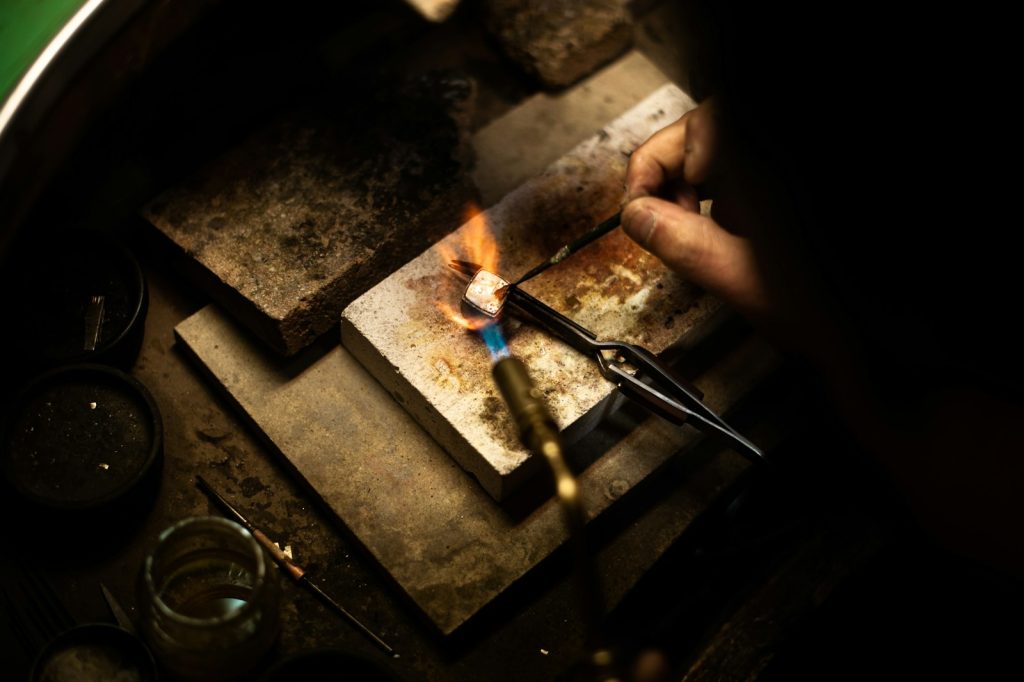
Private label silver jewelry manufacturer means a production partner that makes 925 sterling-silver designs under your brand, with your logo and packaging, for wholesale. Celuk Silver Wholesale operates as an independent sourcing and export desk in Bali that assembles a network of Celuk ateliers into a practical private-label and OEM silver jewelry solution for importers.
What “Private-Label & OEM” Means in Celuk, Practically
In our context:
– Private label sterling silver = existing or lightly modified Celuk designs produced with your logo, your 925 mark, and your packaging.
– OEM silver jewelry = your designs (from sketch, sample, or CAD) translated into production-ready molds and lines in Celuk workshops.
We are not a single factory. We manage a curated group of family-run and medium-scale Celuk ateliers, each with different strengths:
– Some are strong in micro-setting and fine chain.
– Others excel at heavy gauge rings, cuffs, and cast pieces.
– A few can handle integrated brass/bronze parts, semi-precious stones, or vermeil.
Our job is to:
1. Match each item to the right workshop band (capability, MOQ, and lead time).
2. Coordinate design translation, branding, 925 stamping, and packaging.
3. Run quality control and export (FOB Bali) to your nominated forwarder.
We do not promise a single MOQ or lead time for all items; that is rarely honest in Celuk. Instead, we quote from live production data by workshop band.
How the OEM & Private-Label Process Works
For importers, the core questions are always the same: How do I brief? How fast can I get samples? What is the MOQ? How do logo and 925 stamps work?
Below is the standard flow we use for custom branded silver jewelry projects.
Step 1 – Technical Brief
You send us a clear brief per design or line:
– Sketches, moodboards, and/or CAD (STL/3DM preferred).
– Target ring sizes / chain lengths / bracelet sizes.
– Approximate gram weight targets if you have them (we can recommend).
– Stone specs (type, size, cut), if any.
– Surface finish (polished, satin, hammered, oxidized).
– Plating (bare 925, rhodium, gold vermeil, etc.).
– Your branding requirements: logo stamp, 925 placement, packaging.
File requirements for logo stamping:
– Vector artwork (AI, EPS, or SVG) of your logo in one color.
– Simplified mark for stamping, with good legibility at 2.0–3.0 mm.
– Black-and-white version (no gradients).
If your logo is complex, we may recommend a simplified monogram just for metal stamping and keep the full logo for cards and packaging.
At this point we:
– Classify the item by technique (hand-fabricated vs. cast vs. chain + component).
– Assign it to a workshop band (A, B, or C — different MOQs and lead times).
– Flag technical risks (weak points, solder-heavy joints, over-thin areas).
You receive a preliminary feasibility + costing range, based on recent Celuk bench data (labor, silver cost, and finishing factors last verified June 2026).
Step 2 – OEM Engineering & Quotation
Once the brief is clear, we translate it into production specs:
– For CAD-ready designs:
– We validate your STL/3DM files against the target sizes and tolerances.
– We adjust wall thickness to Celuk casting realities (avoid porosity, warping).
– We specify casting tree layouts and finishing steps with the workshop.
– For sketches / reference photos:
– Our CAD partners in Bali build 3D files.
– We circulate tech drawings with dimensions for your approval.
– We estimate gram weights per size (e.g., ring US 6 vs. US 8).
Quotation is provided as:
– Per-piece price range for target order volume (ex-works / FOB Bali, last verified June 2026).
– MOQ by design and by workshop band.
– Mold / tooling fee where applicable (for cast items).
– Estimated sample lead time and production lead time.
We also clarify what can be shared across SKUs. For example:
– A ring, pendant, and earring using the same central casting share one mold cost.
– Component-based lines (same chain, clasps, or settings) can reduce per-SKU MOQ.
Step 3 – Sampling & Prototyping
For each approved design, we produce:
– Master sample in 925 sterling silver (unplated or with your specified finish).
– Optional “pre-production” sample if you want to test packaging and stamping too.
Sample fee policy (ranges, last verified June 2026):
– Simple band, charm, or stud designs: sampling often falls in the US$40–70 per master, depending on CAD and complexity.
– Complex, heavy, or stone-set pieces can be higher, especially if bespoke molds are required.
– CAD creation (if we build files from scratch) is usually an additional, one-time cost per design or per line.
Where possible, sample fees are partially creditable against first bulk orders of that design, subject to workshop agreement. We will state clearly in writing what portion, if any, is creditable before you approve the sampling.
Sampling lead time by workshop band (typical, not a guarantee):
– Band A (agile, smaller workshops): ~2–3 weeks from brief lock.
– Band B (medium, more complex work): ~3–5 weeks.
– Band C (high complexity, stone-heavy or large casts): ~4–6 weeks.
We ship samples via your preferred courier (DHL, FedEx, etc.) on your account or pre-paid and re-invoiced.
Step 4 – Stamp, Logo & Packaging Finalization
Before moving to bulk manufacturing we:
– Confirm final logo stamp artwork (reduced mark) and placement diagrams.
– Confirm 925 stamp style and position (inside shank, on tag, or near clasp).
– Test-stamp on a sample or offcut if needed to check legibility.
Logo stamping options across the Celuk network:
– Hand punch stamps (cost-effective for small and mid-size runs).
– Steel logo dies for repetitive stamping during production.
– For very small or intricate marks, some workshops can work with laser engraving, but this is not universal; we will advise where it is available.
Packaging options:
– Use your own brand packaging shipped to us in Bali.
– Use white-label Celuk packaging and add your cards or stickers.
– Develop basic branded cards or pouches locally (subject to MOQ and print specs).
We can coordinate packing “by SKU” or “assorted,” according to your warehouse requirements (e.g., polybag with barcode label, 12-pack inner, 120-pack master).
Step 5 – Bulk Production
Once samples are approved in writing:
– We lock final specs, gram weights, plating parameters, and QC tolerances.
– We schedule the run with the assigned workshop(s).
– You pay the agreed deposit (percentage depends on workshop; terms shared during quoting).
Typical production lead times (approximate):
– Band A: 3–5 weeks from deposit for small–medium orders.
– Band B: 5–7 weeks.
– Band C or multi-workshop lines: 6–10 weeks.
Lead times are influenced by:
– Order size and SKU count.
– Stone availability (especially calibrated cuts).
– Plating queue (if outsourced).
– Seasonal congestion (e.g., pre-Christmas export rush).
We do not commit to FOB dates we do not believe in; if your deadline is tight, we will say so upfront.
Step 6 – Quality Control, Packing & Export (FOB Bali)
Before shipment we:
– Conduct internal QC by batch and by sample rate, agreed with you (e.g., 100% visual inspection, plus measurement checks on X% of pieces).
– Check functional elements: clasps, ear backs, solder joins, stone settings.
– Verify logo and 925 stamps or laser marks on each SKU type.
– Confirm packing, labeling, and carton marks.
Export scope:
– Prepare commercial invoice and packing list per your requirements.
– Coordinate HS codes (you confirm against your local tariff schedule).
– Liaise with your chosen forwarder or courier in Bali.
– For sea freight or air freight consolidations, coordinate delivery to your consolidator.
All pricing we quote is clearly stated as EXW or FOB Bali, with Incoterms 2020 references. Destination charges, local import duties, and VAT/GST at your end are always your responsibility; we encourage you to verify landed-cost assumptions with your customs broker.
If you are planning a visit to inspect OEM samples in person or meet workshops, you can request a wholesale quote and we can coordinate timing and WhatsApp communication ahead of your arrival.
MOQ Bands & What Actually Drives Them
MOQ in Celuk is not one number. It varies with:
– Workshop size and bench count.
– Casting vs. hand-fabrication.
– Stone work and plating.
– How many components can be shared across SKUs.
We group workshops into three broad bands for planning. These are indicative, not contractual, and will be tailored per design.
| Band | Typical Workshop Profile | Indicative MOQ per Design* | Best For |
|---|---|---|---|
| Band A | Smaller, agile ateliers; strong in hand-fabrication and simple casting | ~50–100 pcs | New brands testing designs, simple private-label sterling silver lines |
| Band B | Medium-scale workshops with casting, stone-setting, and plating partners | ~100–300 pcs | Established brands building multi-SKU OEM silver jewelry collections |
| Band C | Larger or more specialized teams, heavy or complex items, stone-intensive work | ~300–500+ pcs | High-volume lines, complex cuffs, statement pieces, or intricate stonework |
*These are working ranges based on recent Celuk production as of June 2026. Exact MOQ is confirmed per design and workshop.
How Shared Components Reduce Per-SKU MOQs
If you are planning a silver jewelry OEM Bali program, you can often structure your line to share elements:
– Same chain and clasp across several pendants and bracelets.
– Same central casting used on ring, pendant, and earrings.
– Same bezel or prong setting size across multiple stones.
Benefit:
– The overall MOQ for the shared component might be, for example, 500 units, but you can allocate across SKUs:
– 200 pendants
– 150 rings
– 150 earrings
– Each SKU then has a lower effective MOQ, while the workshop still operates efficiently.
We will explicitly flag shared-component opportunities during design review, so you can adjust your line plan.
OEM Step-by-Step: Deliverables & Who Does What
To keep expectations transparent, here’s a summary of each OEM stage, your deliverables, and ours.
| OEM Stage | Your Deliverables | Our Role (Sourcing Desk + Workshops) |
|---|---|---|
| 1. Brief | Design sketches/CAD, logo files, specs, target quantities | Validate feasibility, assign workshop band, initial cost/lead-time range |
| 2. Engineering | Feedback on tech drawings or CAD previews | CAD refinement, gram-weight estimates, mold/tech planning, firm quotation |
| 3. Sampling | Sample PO, payment of sample & tooling fees | Produce master samples, adjust as needed, ship for your approval |
| 4. Branding Setup | Final confirmation of logo stamp and packaging details | Prepare stamps/dies, test stamping/engraving, packaging workflow |
| 5. Production | Bulk PO, deposit, final spec sign-off | Schedule production, manage workshops, ongoing QC checks |
| 6. QC & Export | Share import/compliance requirements, confirm forwarder | Inspection, packing, export docs, arrange FOB Bali handover |
Technical Considerations for 925 Mechanics
Serious private label silver jewelry manufacturers and importers look beyond visuals and into the mechanics. Our Celuk network has deep bench experience with:
Alloy & 925 Compliance
Standard alloy:
– Workshops use 925 sterling silver (92.5% silver, 7.5% alloy metals).
– Alloy mix is typically silver + copper; some workshops can access modified alloys for specific hardness or tarnish performance.
You should:
– Verify that the alloy and 925 stamping approach align with your destination-market requirements (e.g., EU nickel regulations, US FTC guidelines).
– Conduct periodic third-party metal testing at your end for added assurance.
We can assist by coordinating raw-material certifications from suppliers where available, but we encourage independent verification, especially for regulated markets.
Plating & Finishes
Available across our network (subject to workshop band):
– High-polish, satin, brushed, hammered, and oxidized finishes.
– Rhodium plating on 925 to slow tarnish.
– Gold vermeil-style plating (thicker gold layer on silver) via specialist partners.
Consider:
– Plating thickness vs. cost and target price point.
– Country-specific “vermeil” labeling rules (you should confirm locally).
– Care instructions for your end customers.
Stone Setting & Component Sourcing
Capable ateliers in Celuk can handle:
– CZ and synthetic stones.
– Common semi-precious stones (amethyst, garnet, peridot, etc.) in standard cuts.
– Micro-pavé style settings in select workshops.
We can source stones locally or work with your nominated stone supplier (delivered to Bali). Stone lead time and QC are a frequent bottleneck, so realistic timing discussions are important at brief stage.
What You Should Independently Verify
Our role as an independent sourcing and export desk is to coordinate and give you realistic, data-based expectations. However, importers remain responsible for several crucial checks:
- Regulatory compliance in your market for metal content, nickel release, lead/cadmium restrictions, REACH, CPSIA (US), etc.
- Labeling / marking requirements for silver jewelry in your country (925 marks, country of origin, brand marks).
- Import duties and HS code classification via your customs broker.
- Retail price architecture vs. our ex-works/FOB cost ranges and your landed costs.
- Insurance and risk cover for shipments once handed over FOB Bali.
We can share what other importers typically do, but we cannot provide legal or regulatory guarantees. For serious volume programs, independent lab testing and a conversation with your compliance team or consultant is strongly recommended before you commit to large MOQs.
Why Use a Sourcing Desk Instead of a Single Factory?
Some importers prefer dealing with a single “private label silver jewelry manufacturer.” Others see value in a managed network under one export umbrella. Our model suits buyers who:
– Want a range (heavy cuffs, fine stacking rings, chains, etc.) without spreading themselves over multiple vendors.
– Need honest signaling of which workshop is appropriate for a given SKU.
– Value third-party QC and export coordination in Bali.
Comparing working directly with one factory vs. via our Celuk sourcing desk:
- Factory-direct advantage
- Sometimes slightly lower per-piece cost on one type of item, if your line matches that factory’s core strength and volume profile.
- Factory-direct limitation
- Less flexibility if you later add different product types that the same factory cannot execute optimally (e.g., jumping from simple studs to complex hinged bangles).
- Sourcing-desk advantage
- We can assign different SKUs to different ateliers while keeping one commercial and export relationship, and we are not forced to shoehorn every design into one factory’s machinery.
- Sourcing-desk consideration
- There is coordination overhead baked into our pricing; the value is in having technically suitable workshops plus QC and export handled.
For many buyers, especially those building a brand around distinct collections, the flexibility and risk management of a networked approach outweigh the marginal cost difference.
How to Brief a Strong Celuk OEM or Private-Label Project
To get the most accurate pricing and smooth execution for silver jewelry OEM Bali projects, we recommend:
1. Start with a Focused Line
– 8–20 SKUs for first rollout is a realistic target for a new brand or new collection.
– Group items by family: same motif across ring, pendant, bracelet, and earrings.
2. Be Clear on Your Target Price Lanes
Share your planned retail or wholesale brackets:
– Example: “We are targeting a US$35–US$50 retail for simple pendants” or “This cuff line is positioned at US$150–US$200 retail.”
We reverse-engineer appropriate gram weights, process choices, and finishes that fit those lanes while maintaining durability.
3. Define Non-Negotiables vs. Flex Points
Non-negotiables might include:
– Minimum wall thickness or shank thickness.
– Must-have stones or plating quality.
– Brand-signature logo and 925 placement.
Flex points may include:
– Slight changes in overall dimensions.
– Alternative stone options in the same cut.
– Switching from full-solid to partly hollowed structures for cost/weight control.
4. Plan Testing Before Committing to Large MOQs
We encourage:
– Small initial orders at or near workshop MOQ to test sell-through.
– Feedback loops from your customers on comfort, fit, and wear over time.
– Iteration in the second batch based on real data, not assumptions.
This is particularly important for new designs that push Celuk workshops into unfamiliar constructions or highly trend-sensitive shapes.
If you want to map out a phased launch (pilot SKUs, then scale-up), you can request a wholesale quote or schedule a WhatsApp call; we can outline realistic volume ramps based on workshop capacity.
Working with Branding, E‑commerce & Retail Clients
We support different profiles of OEM and private-label clients:
Direct-to-Consumer Brands
Key needs:
– Consistent photography-ready finishing.
– Reliable re-orders with stable gram weights and packaging.
– E-commerce-friendly packaging (individual polybags, SKU labels, etc.).
We can:
– Help standardize hanging cards or boxes that fit common warehouse workflows.
– Coordinate per-SKU labeling or barcoding at packing stage if you provide data and label formats.
Wholesale / Multi-brand Retailers
Key needs:
– Strong bulk-pricing structures.
– Design differentiation from existing supplier base.
– Flexible assortments for orders across multiple seasons.
We can:
– Help you create retailer-exclusive capsules.
– Maintain design records and molds for seasonal reorders or tweaks.
Corporate, Promotional & Limited-Edition Runs
For corporate gifts or limited drops, often:
– Logos and event marks must be incorporated tastefully.
– Timelines are often tight around event dates.
We will be candid on feasibility. Some corporate timelines simply do not fit Celuk working patterns plus export logistics; if we think your deadline is not compatible with quality production, we will tell you clearly rather than overpromise.
Quality Control: What We Check, and How
Our QC approach is practical and grounded in Celuk operations:
Dimensional & Functional Checks
We verify on a sample-check basis:
– Ring inner diameters across key sizes.
– Chain and bracelet lengths within agreed tolerances.
– Clasp function and solder integrity.
– Moving parts (hinges, ear wires) for stiffness and retention.
Visual & Surface Checks
We look for:
– Major surface defects (deep scratches, pits, visible porosity).
– Obvious polishing marks in highly visible zones.
– Inconsistent oxidation or plating (patchy areas).
– Misaligned or illegible logo and 925 marks.
Stone & Setting Checks (if applicable)
– Random sampling for tightness via gentle probe.
– Visual alignment and symmetry.
– Obvious chipped stones or significant color mismatch within a batch.
We are not a third-party lab; our QC is workshop-floor practical. For larger programs and sensitive markets, many importers layer in periodic independent inspections or lab tests, which we can cooperate with.
Getting Started: From First Email to First Sample
To begin a private-label or OEM project with Celuk Silver Wholesale:
1. Email or WhatsApp us via the request a wholesale quote page with:
– A short intro to your brand.
– Target markets and price points.
– Initial design count and type (rings, pendants, etc.).
– Any hard deadlines (trade shows, launches).
2. We respond with:
– An information request for design files and logos.
– A brief on our workshop bands and MOQ expectations relevant to your project.
– Initial questions on compliance and Incoterms.
3. Once we’ve reviewed your material, we:
– Propose a pilot batch of SKUs (if helpful).
– Provide indicative ranges for sampling and production (last verified June 2026).
– Outline a WhatsApp-friendly timeline and decision points.
If you plan to visit Bali, we can align your sampling schedule so you can see masters and workshop conditions in person.
FAQs on OEM & Private-Label Silver in Celuk
What is the minimum order quantity (MOQ) for private label sterling silver designs?
Indicative MOQs range from about 50–100 pieces per design in smaller Band A workshops up to 300–500+ pieces for complex or heavy Band C items. The exact MOQ depends on the workshop, technique (casting vs. hand-made), and whether components are shared across SKUs. We confirm MOQs per design after reviewing your specs with the relevant atelier.
Can you produce from my existing samples or only from CAD and sketches?
We can work from physical samples, sketches, photos, or CAD. If you send a physical sample, we will reverse-engineer dimensions and gram weights, then create CAD or technical drawings as needed. For accuracy and IP clarity, we still prefer having your written confirmation of key dimensions and any changes you want from the original.
How do logo and 925 stamps work for custom branded silver jewelry?
You provide a simplified vector logo suitable for small-size stamping. We develop or source appropriate stamps or dies, agree on placement on each SKU, and test legibility during sampling. 925 marks are applied according to your market’s expectations, typically inside rings or near clasps. Some workshops offer laser engraving for very fine marks; others use traditional steel stamps.
What are typical sample and production lead times?
After finalizing designs, sampling generally takes about 2–6 weeks depending on complexity and workshop band. Once samples are approved and deposit is paid, production usually takes 3–10 weeks. These ranges are based on recent Celuk data and can be longer during peak export seasons or for stone-intensive designs. We will always quote case-specific lead times with your project.
Can you handle shipping and customs clearance to my country?
We handle export from Bali on an EXW or FOB basis, including invoices, packing lists, and coordination with your forwarder or chosen courier. Customs clearance, import duties, taxes, and local compliance checks remain your responsibility. We strongly recommend working with a local customs broker to confirm HS codes, duty rates, and regulatory requirements before confirming large OEM orders.