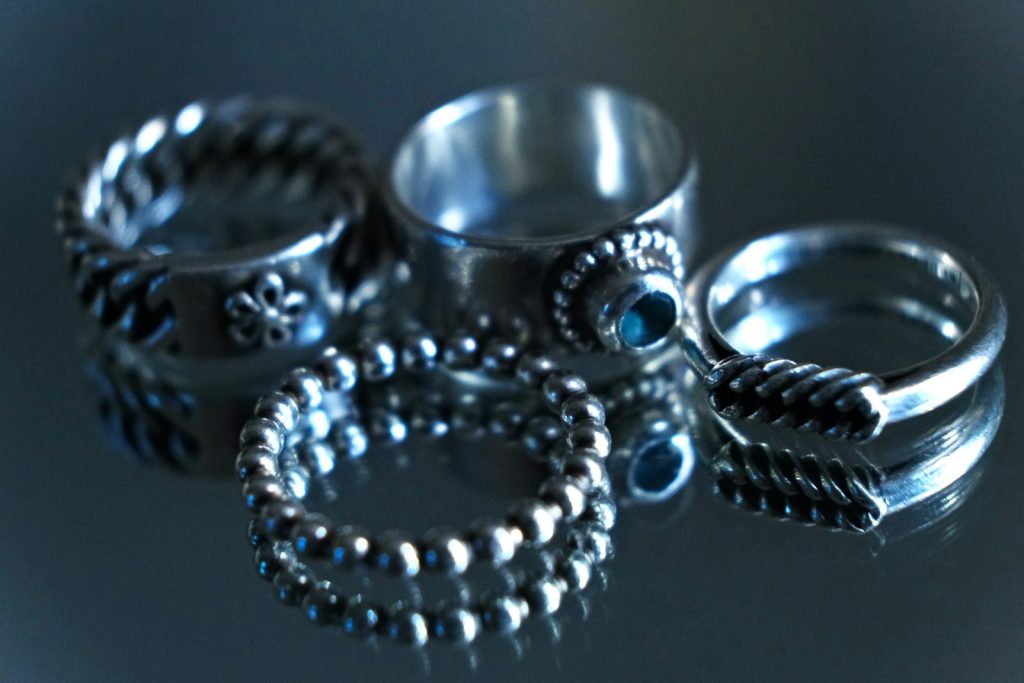
Minimalist silver jewelry wholesale means sourcing dainty, everyday 925 sterling-silver pieces in volume: thin bands, tiny studs, fine chains and simple silhouettes made for stacking and daily wear. At Celuk Silver Wholesale, that is our main export segment in 925 — small-gram, repeatable SKUs with consistent quality, ready for private-label and DTC brands.
What “minimalist” and “demi-fine” mean in 925 from Celuk
For importers, “minimalist” and “demi-fine” are not just aesthetics; they affect gram weight, costing, plating spec and QC checkpoints.
Working definition for sourcing
- Minimalist 925 jewelry: clean shapes, low visual complexity, low weight. Think 0.5–1.5 g rings, 0.2–0.6 g stud earrings, 1.5–3.0 g chain necklaces (without pendant).
- Dainty / everyday: designed to be worn daily, often stacked. Clasps and solder joints must handle frequent use despite thin wire and chain gauges.
- Demi-fine: sterling silver base (Ag 92.5%, Cu 7.5%) with higher-end finishing. Typically:
- Micron gold-plated 925 (0.5–2.0 µm) or vermeil-grade on silver.
- Anti-tarnish e-coating on exposed silver.
- Rhodium plating on bright white pieces.
Our core production is minimalist 925 jewelry from Bali, made in and around Celuk village. We combine traditional bench skills with simple, modern forms: no ornate filigree unless you request it; clean surfaces, straight lines, tiny stones.
Why minimalist 925 sells for DTC and marketplaces
Most of our repeat shipments to DTC brands and marketplace sellers are not “hero” statement pieces. They are quiet, repeatable SKUs that move every season. Minimalist silver fits this role.
Everyday wear and stackability
- Daily wear: Lightweight, non-snagging and neutral. 925 is nickel-free by composition, which helps with sensitivity messaging (you should still avoid promising “hypoallergenic” without lab evidence).
- Stacking: Thin bands and chains stack visually and in cart value. One customer often buys 3–5 units: ring sets, multi-piercing studs, layered chains.
- Self-gift and gifting: Price points stay accessible when gram weights are low. This supports AOV-building bundles and gift sets.
Operational reasons: lower risk per SKU
- Lower metal exposure: On a per-piece basis, silver content is lower, so inventory risk per SKU declines.
- FOB flexibility: You can test a motif or size run without committing to heavy, high-value items.
- Replenishable: Simple minimalist shapes rarely go “out of fashion” completely. If a line moves, it is usually safe to reorder for multiple seasons.
For these reasons, most new-importer programs we support start with a minimalist/dainty assortment, then layer on more complex or higher-ticket lines once sales data is stable.
What Celuk Silver Wholesale actually does
We are an independent Celuk 925 sterling-silver sourcing and export desk. We are not a single factory; we work with a controlled network of Balinese workshops and finishing houses. Our role is:
- Translate your line sheets into Balinese 925 manufacturing language (wire gauges, stamp positions, casting vs. fabrication, plating specs).
- Source across multiple small and medium workshops while standardising QC.
- Consolidate orders, verify 925 content via supplier assay documentation or external testing on a sampling basis, and manage export (pack, paperwork, handover).
- Support OEM and private-label production: stamps, packaging integration, and if needed, basic CAD and prototyping via our partner shops.
For buyers, this setup is useful if you want everyday silver jewelry suppliers in Bali without needing to vet ten workshops yourself. You still need to do your own due diligence on our entity and terms. We encourage it.
Typical minimalist product families we supply
Below is how “minimalist” translates into concrete SKUs and gram weights. All weights are indicative and vary by size and specification.
1. Dainty silver rings (stackers and band sets)
- Plain stackers: 0.5–1.2 g per ring in size US 6–8.
- Round, square or half-round profiles.
- Polished, brushed, hammered or sandblasted finish.
- Optional micro pavé accent (increases gram weight and setting cost).
- Shaped bands: 0.8–1.6 g.
- Chevron/V-shape, wave, twist, signet-minis.
- Good for stacking under solitaires or charms.
- Demi-fine / gold options:
- Yellow, rose or white gold colour over 925.
- Standard plating range we see ordered: 0.5–1.0 µm for fashion, 1.0–2.0 µm for higher-end demi-fine (you should specify this, not leave it open).
2. Tiny studs and huggies
- Studs: 0.2–0.6 g per piece, simple shapes: dots, bars, tiny hearts/stars, minimal bezel stones.
- Huggies: 0.6–1.4 g per piece depending on diameter and wall thickness.
- Clicker and wire hinge constructions available.
- Smooth, micro pavé, or minimal charm drops.
- Closure hardware:
- Standard butterfly backs in 925 or 925 with silicone insert.
- For sensitive-skin branding, some buyers specify rhodium on posts.
3. Fine silver chains and simple pendants
- Neck chains (without pendant): 1.5–3.0 g at 40–45 cm for fine cable, curb, box or snake chains.
- Bracelet chains: 0.8–1.8 g at 16–18 cm.
- Pendants and charms:
- Geometric plates (disc, bar, rectangle).
- Mini motifs (moon, star, zodiac symbols, initials).
- Lightweight settings for tiny faceted stones or cabochons.
4. Bar necklaces, dot stations and layering pieces
- Bar necklaces: chain + simple bar (solid or hollow). Often 2.0–3.5 g total.
- Station necklaces: fine chain with small discs, bars or beads soldered at intervals.
- Y-necklaces and threaders for more fashion-forward DTC brands.
5. Minimalist Balinese touches
If you want a quiet tie to Bali without ornate filigree, you can specify:
- Micro granulation rows on ring shoulders or edges.
- Oxidized grooves or line details that recall traditional work but stay minimalist.
- Brushed-oxidized contrasts on signet tops or bar surfaces.
FOB, MOQ bands and costing logic for minimalist 925
We do not post fixed prices because they depend on live silver, labor, finish and order structure. Below is how minimalist 925 costing usually breaks down, so you can forecast.
Key cost drivers
- Metal weight: Dominant factor for plain silver. Your line sheet should indicate target gram weights or at least profile thicknesses.
- Process:
- Fabricated (wire/sheet) vs. cast parts.
- Hand finishing level (polish only vs. texture vs. stone-setting).
- Finish:
- Raw polish vs. rhodium vs. e-coat vs. gold plating.
- Plating thickness in microns on demi-fine lines.
- Order complexity:
- Number of SKUs and variants (sizes, colours).
- Packaging and barcoding integration, if any.
Indicative FOB and MOQ patterns
The following table summarises the patterns we typically see for minimalist and dainty silver jewelry wholesale orders from Bali. These are not quotes; they are patterns only, based on mixed orders and live silver, last verified June 2026. You should always request a current quotation.
| Category | Typical MOQ band (per SKU) | Indicative FOB pattern (Bali) | Notes |
|---|---|---|---|
| Plain stacker rings (silver only) | 100–300 pcs per size per SKU | Low unit price; driven by wire weight + polish | Best entry SKU; simple QC; minimal returns if sizing is clear. |
| Rings with micro stones | 100–200 pcs per size per SKU | Higher than plain rings; labor for setting dominates | Stone sourcing and setting yield can affect lead time and scrap. |
| Tiny studs (shapes, no stones) | 200–500 pairs per SKU | Very low metal cost; labor and plating dominate | Often ordered in multi-SKU packs (e.g., 10–30 designs at once). |
| Huggies with pavé | 100–200 pairs per SKU | Higher unit cost due to casting + pavé setting | Critical to lock in stone size, cut and colour tolerance. |
| Fine chains (necklace/bracelet) | 100–300 pcs per length per SKU | Moderate; more silver weight but simple assembly | Chain thickness and clasp spec are key to avoiding returns. |
| Demi-fine gold-plated 925 | 100–200 pcs per SKU per colour | Base silver + plating surcharge by micron range | Specify target micron and colour tone; plating lab reports available on request. |
We normally consolidate across SKUs to hit a viable export lot (carton) rather than forcing one high MOQ per item. But very low quantities (e.g., 10 pcs/SKU) are rarely efficient once you include sampling, setup and export overhead.
If you already have target FOB corridors per category (e.g., “landed cost ceiling for stud earrings”), we can design around that by controlling weight and finish. If not, we will ask for your retail price range and work backwards, but you must stress-test our quotes against your own margin and freight assumptions.
Quality mechanics: 925, finishing, and real-world tolerance
Buyers in the demi-fine bracket sell on “sterling”, “gold vermeil” and “tarnish-resistant” claims. Those are legal and chemical statements, not marketing adjectives. This is where you need clear specs.
925 sterling basics
- Composition: 925 parts silver, 75 parts copper per thousand by mass. This is global standard for “sterling” and what we work with in Celuk.
- Hallmarking:
- Most minimalist pieces can carry a “925” / “STERLING” stamp on an inner surface, tag, or clasp.
- Very tiny parts (micro studs, super-thin rings) may not have space for a legible stamp without weakening the piece. In that case, we can place the mark on ear backs, extension chains or hang tags where applicable.
- Assay control:
- We source 925 from suppliers with composition certificates and, on a sampling basis, cross-check via independent testing as part of our QC program.
- If you need your own lab test in your country, plan the timeline — customs inspection and lab queues can delay launch dates.
Anti-tarnish e-coating and rhodium
Minimalist pieces expose more surface relative to volume, so finishing matters for your returns rate.
- Anti-tarnish e-coating:
- Thin, transparent coating applied by electrophoretic deposition.
- Slows down silver sulphide formation (tarnish) in normal conditions.
- Can subtly warm the tone vs. raw rhodium-bright silver; usually acceptable for minimalist lines.
- Rhodium plating:
- Gives a bright, cool-white finish and additional tarnish resistance.
- Typically specified on studs, chains and high-contact parts like ring outer surfaces.
- It will wear over time, faster on rings and bracelets. Communicate care instructions to your customers.
- Gold plating / vermeil:
- Yellow and rose plating thickness affects both durability and price.
- If you plan to use “gold vermeil” language in US or EU markets, review your local legal definition (often 925 base plus minimum gold purity and thickness) and specify those numbers in your PO.
Balinese oxidation vs actual defects
Bali workshops traditionally use oxidized finishing to darken recesses and highlight granulation and filigree. On minimalist lines, we usually keep oxidation subtle or avoid it, unless you request a contrast detail.
- Intentional oxidation:
- Even, controlled darkening in recessed lines, grooves and inside textures.
- Part of the design. It should not flake off under normal handling.
- Defects:
- Patchy black, rainbow or chalky areas on flat surfaces that should be bright.
- Solder stains, polish burns, or residual polishing compounds.
Our QC instructions differentiate between intentional Balinese oxidation and contamination. For minimalist SKUs that are meant to be bright white, we specify: no decorative oxidation.
How our QC runs for minimalist and dainty lines
Minimalist looks “simple”. In reality, it exposes defects — there is nowhere to hide polish lines or casting pits. Our QC for these lines is stricter than for heavy carved pieces.
Key QC checkpoints
- Dimensional control:
- Ring sizes checked with mandrels; micro tolerances defined in advance (e.g., +/- ¼ US size tolerance or specific inner diameter mm).
- Chain lengths measured under light tension, taking clasp and extension into account.
- Surface finish:
- Polish lines should be consistent; no deep scratches on open, flat surfaces.
- For brushed/matte surfaces, direction and grain density controlled to your reference sample.
- Solder joints and moving parts:
- Tiny jump rings, bar connections, huggie hinges tested for strength.
- Pendant bails checked for free movement without catching.
- Plating/E-coat inspection:
- Visual uniformity, no “burn” marks or drips.
- Random destructive tests in pre-shipment samples where agreed (e.g., tape tests, abrasion) to estimate wear resistance.
For larger accounts, we can work to an AQL sampling plan aligned with your internal standards. For smaller importers, we usually agree a practical inspection level that balances cost and risk.
OEM and private-label options for minimalist 925
Most of our minimalist silver shipments are not generic. They carry a brand’s own marks and sometimes proprietary shapes.
Branding and marks
- Logo stamps on inside bands, tags or clasps, alongside 925 / STERLING.
- Country-of-origin marks where legally required or brand-driven (e.g., “INDONESIA”, “MADE IN INDONESIA”). Check your market’s labelling norms.
- Batch/lot codes in subtle locations if you need traceability for warranty or recall programs.
Design development
- Existing catalog selection: fastest route. We adjust gram weight, finish and stones to your brief.
- OEM from sketches:
- We convert your sketches or flat art to technical instructions (or CAD via partner) for the workshops.
- Sampling round(s) with clear comments before mass production.
- Line architecture:
- Coordinated sets: ring + stud + necklace + bracelet around a single minimal motif.
- Good for bundled selling (e.g., 3-piece gift sets).
Packaging and prep
- Bulk polybag as default for FOB; individual boxes are usually done at destination to save volume and freight.
- Carding and bagging in Bali is possible if you supply or specify cards and bags sized for minimalist items.
- Barcoding/labeling support on outer packs and polybags if you provide the format.
If you want to configure an OEM or private-label program around minimalist 925, share your current catalog and we can map which SKUs are realistic for Balinese production and which might need adjusting. You can request a wholesale quote or remote sourcing program with us; WhatsApp coordination is standard for sampling and approvals.
Export, Incoterms and documentation
Our default trade setup is FOB Bali (port or airport as agreed) on confirmed Incoterms (e.g., FOB, FCA). We regularly support LCL and airfreight for minimalist orders, as weights are modest.
Incoterms and logistics
- FOB / FCA:
- We handle inland logistics, export clearance and handover to your nominated forwarder or a forwarder we coordinate with.
- You control main carriage, insurance and arrival charges.
- CIF / CFR:
- Possible if you need us to arrange the main carriage; we still recommend you compare quotes with your own forwarder.
- Air vs. sea:
- Minimalist 925 is high value per kg, so many buyers choose air for initial drops or small replenishments.
- Once volumes grow, mixed air/sea strategies are common: core SKUs by sea, fashion capsules by air.
Documentation and compliance
- Commercial invoice and packing list with HS codes for silver jewelry by type (rings, necklaces, earrings, etc.).
- Certificate of origin from Indonesia if your country uses it for tariff preferences.
- Materials declarations for 925 and plating where requested.
- Test reports:
- We can share available lab reports from our network when relevant (e.g., nickel release on plated components), but you should verify which tests your destination’s regulations require.
It is your responsibility to confirm duty rates, hallmarking requirements (for example, state assay office marks in certain markets), and labelling obligations in your import country. We can assist with Indonesian-side paperwork, but we do not act as your customs broker abroad.
How to brief minimalist silver and avoid common problems
Minimalist and dainty silver jewelry wholesale orders are simple in concept but can fail in details. Below are practical points that reduce friction.
Be precise on thickness and weight
- Specify target wire diameter (e.g., 1.0 mm round wire) rather than “thin”.
- Indicate a target weight range per size where possible, so we can balance feel with cost.
Define finish and oxidation in writing
- Use clear terms: “high polish bright, no decorative oxidation” or “satin brush, light oxidation in engraved lines only”.
- Send physical reference pieces or professionally lit photos if finish is a key selling point.
Lock in plating specs for demi-fine
- Gold colour (e.g., 14K-yellow tone vs. 18K-rich yellow) and micron thickness ranges.
- Substrate prep: e.g., silver → barrier layer (nickel-free, as required) → gold.
- Any regional regulations you need to meet; we can align processes but cannot interpret law for your market.
Plan for sampling and iteration
- Expect at least one physical sample round before bulk, especially on new closures or chain choices.
- Build that time into your launch calendar alongside shipping and customs clearance.
Working with Celuk Silver Wholesale on minimalist lines
If your brand strategy leans into quiet, daily-wear 925, Bali is a practical manufacturing base. The workshops here are used to thin wires, small solder work, and hand-finishing simple geometries at volume.
We act as your interface into this ecosystem: sourcing across multiple suppliers, aligning them on your 925, finish and QC requirements, and consolidating into export-ready lots. We are candid about what works and what does not at different price points and MOQs. You still own the final decision and should assess us like any trade partner.
To scope a project, share:
- Your intended catalog (existing SKUs, sketches or mood boards).
- Target retail price ranges and markets.
- Desired plating/finish tiers (plain 925, rhodium, demi-fine gold-plated).
- Approximate initial quantity and reorder expectations.
From there, we can propose which pieces to start with, sample timelines, and an initial MOQ/FOB structure that matches your risk tolerance. You can request a wholesale quote to Bali for an in-person sourcing visit or handle the entire process remotely; WhatsApp is our day-to-day channel for pattern approvals, finish checks and status updates.
FAQs: Minimalist & demi-fine 925 from Bali
What is a realistic starting MOQ for a new minimalist 925 brand?
Many new buyers start around a few thousand pieces total across 10–30 SKUs, with MOQ bands of 100–300 pieces per SKU (and per size for rings). This keeps per-SKU risk manageable while creating enough volume for efficient production and export. Very small runs are possible but tend to carry higher per-unit costs once sampling and overhead are factored in.
Can you match my existing minimalist designs exactly?
In many cases we can get very close, but exact replication depends on construction, proprietary elements and legal/IP considerations. We prefer that you either own the designs or confirm permission to produce them. We then work from your samples or drawings, generate technical specs, produce samples and refine until you sign off. Micro differences in weight and feel are normal across manufacturing regions, so we focus on function, silhouette and tolerance.
How durable is gold-plated demi-fine 925 for everyday wear?
Durability depends on gold thickness, colour, the customer’s habits and where the piece is worn. Rings and bracelets experience more abrasion than earrings and necklaces, so we generally recommend thicker plating for those. Even well-plated demi-fine pieces will show wear over time with daily use. It is important not to oversell permanence in your marketing; position demi-fine accurately and offer care guidance (avoiding chemicals, storing dry, etc.).
Do you provide lab certificates for 925 and plating thickness?
We maintain supplier documentation on 925 composition and can arrange third-party lab tests on a sampling basis where justified by volume or regulatory need. For plating, labs can measure thickness and purity on sample pieces. These services add cost and time, so we usually align them with your compliance requirements. You should still plan for any destination-country testing you intend to conduct independently.
Can you handle hallmarking for markets with specific assay-office rules?
We can provide standard 925 or STERLING marks and origin marks in Bali. For markets where official assay office hallmarks are mandatory, you usually need to handle that process in-country or via approved channels. We can ship goods with the required base marks and documentation, but you should coordinate with your local assay authority or compliance advisor to avoid delays or seizures at import.