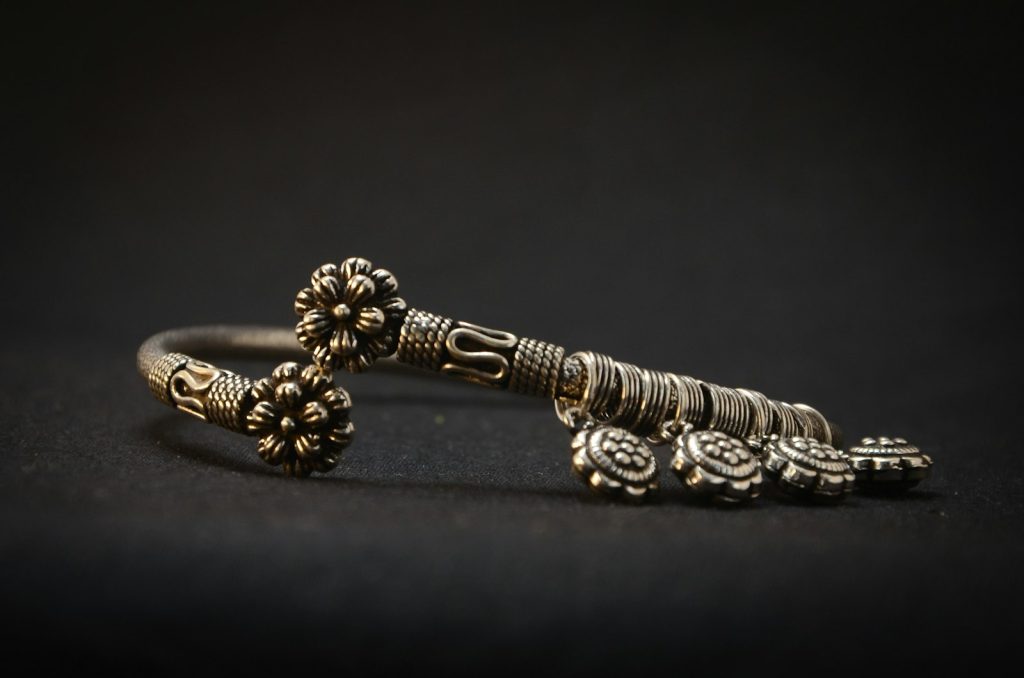
Wholesale silver bracelets are bulk orders of 925 bracelets sold by gram weight and design, with agreed MOQ, lead time and export terms. At Celuk Silver Wholesale, “wholesale silver bracelets” means factory-direct 925 production from Bali with controlled alloys, gram weights, and QC sign-off ready for import.
Wholesale Silver Bracelets & Bangles From Celuk, Bali
Celuk village in Gianyar, Bali is Indonesia’s main 925 silver craft cluster, with workshops that specialize in filigree, granulation, traditional oxidation and modern minimalist lines. Celuk Silver Wholesale operates as an independent sourcing and export desk based in this cluster, coordinating bracelet and bangle production for importers, brands and distributors.
We work primarily in 925 sterling silver bracelets and 925 silver bangles wholesale, finished in:
- Oxidized Balinese motif (traditional blackened relief)
- Plain high-polish 925
- Anti-tarnish e-coating (clear nano-layer)
- Rhodium-plated 925 for bright white color and higher tarnish resistance
Our role is to match you with a compatible silver bracelet manufacturer in Bali, standardize specifications, manage QC against agreed checkpoints, and ship under the Incoterms you choose. We are not a single factory; we curate and coordinate multiple small and mid-size Celuk workshops under a unified QC and documentation process.
Bracelet & Bangle Types We Source
Bracelets and bangles divide into several mechanical and design families that affect gram weight, price band, and QC focus. Below are the main lines we handle in 925 silver bangles wholesale and bracelet programs.
Solid Bangles (Closed Circles)
Solid bangles are continuous circles with no opening. They are usually cast or heavy-drawn wire, making them gram-heavy and cost-driving in any order mix.
- Profiles: round, half-round, flat, square, twisted, rope.
- Width options: approx. 2–12 mm, with wider profiles often stacked as hero pieces.
- Typical inner diameter: 60–68 mm for women’s; 68–74 mm for men’s/oversize, subject to your market.
Because material volume is high, gram weight has a larger impact on FOB than labor. Small reductions in thickness can move you into a more efficient price band.
Hinged & Clasp Bangles
Hinged bangles open via hinge and clasp systems to fit narrower hands or reduce required inner diameter.
- Mechanisms: box clasp with safety, tongue-and-groove, pressure snap, friction hinge.
- Pros: easier fit across sizes; can use more rigid or sculptural profiles.
- Cons: moving parts require tighter QC on alignment, spring tension, and solder integrity.
As your silver cuff wholesale supplier for this category, we specify hinge pin thickness, clasp tolerances and cycle-test counts (open/close cycles sampled per batch).
Open Bangles & Cuffs
Open bangles and cuffs have a gap, typically 20–35 mm, that allows flexing over the wrist.
- Open bangles: simple bar profiles with a gap; minimal design or small motif ends.
- Cuffs: wider bands (10–35 mm), sometimes flared or tapered, often with Balinese ornament or filigree.
In Balinese production, cuffs are a core specialty: heavy gauge base with applied granulation, braid, jawan (dot) patterns, or heavy oxidation for relief. Those details increase labor hours per piece, so unit price is not linear to gram weight.
Chain Bracelets
Chain bracelets cover classic and Balinese-specific link styles in 925:
- Balinese chain: woven styles often called “Borobudur”, “Popcorn”, “Foxtail”, or “Wheat” in export catalogs.
- Standard chains: cable, curb, figaro, box, snake, rolo, paperclip.
- Closures: lobster, spring ring, toggle, box clasp, S-hook (traditional Balinese).
Gram weight range varies widely from fine 1.2–1.5 mm chains to heavy men’s foxtail at 5–7 mm. For chain bracelets, imported clasps or machine-made chain can be combined with local finishing to hit price targets; we can separate “fully handmade” vs “machine-assisted” in your product spec list.
Charm & Bead Bracelets
Charm bracelets use a chain or bangle base with interchangeable or fixed charms.
- Bases: snake chain, rolo chain, solid bangle with threaded ends.
- Charms: cast motifs, Balinese beads, gemstone-set dangles, engraved discs.
- Mechanics: stopper beads, screw threads, clip-on bails, soldered fixed charms.
For private-label charm systems, we match thread and core diameters to your existing SKU, or develop a proprietary spec. Be explicit if compatibility with major European charm systems is required; we will not claim compatibility unless verified with actual components.
Gemstone & Tennis-Style Bracelets
Gemstone bracelets combine 925 bases with natural, enhanced, or synthetic stones.
- Stone types from Celuk workshops: commonly amethyst, blue topaz, garnet, peridot, citrine, rainbow moonstone, onyx, and various cabochon quartzes. Availability depends on current stone supply; we confirm per order cycle.
- Setting types: bezel, prong, flush, channel, pavé-style micro-settings on cast parts.
- Tennis-style: repeated prong or bezel links with box clasp and safety.
We check stone size consistency, seat depth, and prong security by sample pull tests and loupe inspection at agreed AQL levels. If you require specific origin or treatment disclosures for stones, your compliance team should provide wording and thresholds; we can verify only what supplier documentation and basic gem testing support, not full lab-grade certification.
Boho, Minimalist & Men’s Lines
Bali is known for ornate Balinese-motif bracelets, but Celuk workshops also produce plain, minimalist and men’s-focused lines:
- Boho: braided leather with 925 clasps, mixed bead strings, fringe charm chains.
- Minimalist: fine bar bracelets, slim cuffs, small geometric links, thin chain with micro-motifs.
- Men’s: heavier chains, wide cuffs with limited ornament, oxidized finishes, leather-and-silver combinations.
Men’s bracelets typically run longer (19–22 cm) and heavier in gram weight, affecting your target FOB band and retail markup.
Filigree & Granulation Cuffs (Balinese Specialty)
Balinese filigree and granulation cuffs are a core craft from Celuk: hand-drawn fine wires and tiny jawan spheres soldered onto a formed base. These are usually oxidized then polished back so the recessed detail reads dark against bright silver.
Labor is significant. For buyers, that means:
- Lower material share, higher labor share in cost structure.
- Greater dependence on artisan skill; QC focuses on symmetry and solder cleanliness.
- More natural variation across a batch. Perfect micro-symmetry like CNC parts is unrealistic; we define tolerances up front.
Bracelet Sizing & Fit For Wholesale Orders
Sizing errors drive returns more than alloy or tarnish. For large programs, we recommend building your bracelet size matrix into the purchase order and QC sheet.
Length & Inner Diameter Standards
- Chain & link bracelets (adult): commonly 16–21 cm total length, with 18–19 cm as a standard for women’s and 20–21 cm for men’s. Many importers specify a 3 cm extension chain for flexibility.
- Solid bangles: inner diameter typically 60, 63, 65, 68 mm; men’s/oversize 70–74 mm.
- Cuffs & open bangles: inner circumference is more relevant than diameter. A common starting spec is approx. 150–165 mm metal length plus a 25–30 mm gap for women’s, heavier and slightly longer for men’s.
- Charm bases: similar to chains, but market-specific; EU markets often prefer 17–19 cm with size increments of 1 cm.
We measure with calipers and steel rulers at QC. If you use a specific chart (e.g., US vs EU wrist metrics), we align to your chart and note tolerances, normally ±0.3–0.5 cm on chain length and ±0.5 mm on bangle diameter unless you request tighter tolerances.
Size Grading & Assortments
Many importers do not want single-size bulk. Common patterns:
- Ratio packs (for example, S:M:L = 2:3:1 per dozen).
- Three-size graded bangles per style with separate SKUs or internal codes.
- Single adjustable cuff model intended to flex within a range (though this has limits for very small or very large wrists).
Your order sheet should state both size labels (S/M/L) and physical measures (cm/mm). We do not guess your market’s “medium” size definition.
Gram Weight, Cost Drivers & FOB Ranges
In wholesale silver bracelets, your primary hard cost is silver weight, then labor and finishing. Celuk workshops typically buy 99.9% pure silver grain or casting grain, alloy to 925 with copper and minor metals, then convert into sheet, wire or cast parts.
Understanding Gram Weight
Each design’s gram weight is normally quoted as an average per piece for the base size (e.g., 18 cm chain or 65 mm bangle). Key points:
- Slight variation of +/- 5–10% per piece is normal with handmade work.
- Heavier bangles and cuffs (20–40 grams) feel more premium but tie up more capital.
- Fine chain bracelets may be 2–4 grams; stacking sets or bundles can still generate healthy perceived value.
We recommend modeling your landed cost under conservative weight assumptions (e.g., +5% to the quote) to absorb natural variation.
Typical FOB Ranges (Last Verified June 2026)
Because silver spot prices move daily and each workshop quotes in bands by weight and labor, any prices here are indicative only and must be reconfirmed in your actual RFQ. That said, for planning purposes, many importers planning 925 silver bangles wholesale from Celuk see approximate FOB Bali bands such as:
- Light chain bracelets (2–4 g, simple): low single-digit USD per piece at moderate MOQs.
- Mid-weight chains (5–10 g) or basic open bangles: mid single-digit to low double-digit USD.
- Heavy solid bangles or wide cuffs (20–40+ g, low detail): upper single-digit to mid double-digit USD depending on width and finish.
- Filigree cuffs with complex handwork: often priced more on labor than weight; expect meaningful premiums over a plain cuff of equivalent grams.
- Gemstone or tennis designs: add both labor and stone cost; premiums vary with stone type, size and setting complexity.
All FOB indications assume standard brass or 925 clasps where specified, generic packaging, and volume orders, not one-off sampling.
Other Cost Inputs
- Coatings: Rhodium or e-coating adds per-piece finishing cost and may carry minimum batch charges.
- Hallmarking: Local 925 stamping is standard; official assay/hallmark in your destination market (e.g., UK hallmarking) is a separate process and cost on your side unless specifically arranged.
- Tooling & molds: New private-label designs may require mold fees or CAD fees; we define these in writing before you commit.
MOQ, Lead Times & Incoterms
As an independent silver cuff wholesale supplier and sourcing desk, we coordinate MOQs across small artisan workshops and more industrial-capable factories in Bali.
MOQ Bands
MOQ depends on the production route:
- Existing standard models: often 30–100 pieces per style per size combination, sometimes lower in mixed orders with many SKUs.
- New cast designs: mold cost plus MOQ per casting tree; common ranges are 50–150 pieces per model, subject to detail and stonework.
- High-labor filigree cuffs: MOQs may be lower per style, but workshops may require longer lead times and limited monthly capacity.
We will not promise “no MOQ”; instead, we clarify realistic bands and how mixed-order aggregation works (for example, combining multiple bracelet SKUs to reach overall workshop minimums).
Lead Times
Indicative production lead times, excluding international freight and customs clearance:
- Repeat orders of standard lines: often 3–6 weeks from deposit to ready-for-shipment, depending on capacity and volume.
- New development (OEM/private label): sampling adds several weeks; allow at least one full development cycle before bulk production.
- Peak seasons: pre-holiday months can stretch timelines; early booking matters.
Lead times are confirmed in each PI (Proforma Invoice). Force majeure or disruptions (e.g., material delays, local holidays) are flagged as early as possible, but importers should keep a buffer in their retail calendars.
Incoterms & Shipping
Most bracelet and 925 silver bangles wholesale shipments leave Indonesia as:
- FOB Denpasar (DPS) or Surabaya (SUB): we deliver export-cleared goods to the named port/airport; you book international freight.
- CIF main ports on request: where we coordinate freight and insurance through partners.
We specify Incoterms (currently Incoterms® 2020) explicitly in offers and PIs. If your team is new to importing from Indonesia, we can outline typical documentation — commercial invoice, packing list, HS codes, certificate of origin (if applicable) — but you remain responsible for verifying your customs and duty obligations with a licensed broker in your country.
925 Sterling, Hallmarking & Finishing Options
“Sterling silver” in practical trade terms means an alloy with a minimum of 92.5% silver by mass (925/1000). In Celuk, workshops traditionally produce 925 alloys, sometimes slightly above the minimum, using copper and small amounts of other metals for strength and workability.
925 Alloy & Marking
- Composition: 92.5% pure silver, approx. 7.5% copper and permitted minor metals.
- Marks: local practice is to stamp “925” on a discreet area of the bracelet — near clasp, inside of cuff, or near bangle edge.
- Brand stamps: your brand or maker’s mark can be added as a separate stamp, subject to tooling and alignment with your legal obligations (for example, if your jurisdiction treats such stamps as responsibility marks).
Independent lab alloy testing can be arranged at your cost if you require additional assurance beyond workshop controls and in-house testing.
Oxidized vs Defect: Reading Balinese Finishes
Balinese bracelets often use deliberate oxidation: the silver is darkened in recesses, then polished on raised areas. Importers unfamiliar with this can mistake well-executed oxidation for tarnish or dirt.
Key distinctions:
- Intentional oxidation: consistent dark tone in recessed patterns, uniform along the design, with bright polished high spots.
- Defect tarnish: patchy, random discoloration, sometimes with yellow or rainbow tones, or uneven film in non-recessed areas.
- Polishing marks: fine directional lines on plain surfaces; some visible lines are normal in handmade work, but deep scratches or rough unpolished zones are QC rejects.
Our QC checklists explicitly distinguish “designed oxidation” from “contamination or tarnish” and your buy sheet should do the same. If your market prefers bright white, we recommend rhodium-plated or fully high-polish lines with minimal oxidation.
Anti-Tarnish E-Coating
Clear anti-tarnish e-coating (nano lacquer) is an option across many bracelet styles:
- Reduces early tarnish in retail and home environments.
- Creates a thin barrier; feel is slightly different vs raw 925 or rhodium, but most retail customers accept it.
- Can slightly mute extreme high-polish compared with bare metal.
E-coating is not impervious; long-term wear, abrasion and chemicals will eventually break it down. We position it as a support for your retail experience, not a permanent shield.
Rhodium Plating
Rhodium-plated 925 bracelets have a harder, bright-white surface finish, commonly used in minimalist, tennis and modern collections.
- Helps visually match 925 with white gold products in multi-metal assortments.
- Improves short to medium-term tarnish resistance.
- Requires more careful thickness control on moving parts (hinges, clasps) to avoid fit issues.
We record rhodium specifications in microns where applicable. Typical fashion jewelry thickness is in the lower micron range; if you require heavier plating, that must be called out clearly in RFQs and will affect cost.
Quality Control For Bracelets & Bangles
Our QC process is built around bracelet mechanics, finishing, and 925 content. We align to your AQL standards where provided; if not, we propose practical baselines and document them PO by PO.
Mechanical & Wear Tests
- Clasp function: sample cycle testing (open/close) checking for misalignment, weak springs, or rough edges.
- Chain joints: checking for unsoldered or partially soldered links where solder is specified; intentional open-link designs are exempt.
- Cuff flex: confirming cuffs flex within a safe range without visible stress cracks or deformation under moderate hand pressure.
- Stone security: finger tap and light probe to detect loose stones in prong or bezel settings.
Surface, Solder & Hallmark Checks
- Polish level: consistent with spec (high-polish, satin, brushed, or oxidized-relief).
- Solder joints: no visible pits, overflows, or cold joints at visible areas.
- Porosity on cast parts: visible pitting beyond defined tolerance = reject or rework.
- Stamping: 925 and brand stamps present, legible and correctly positioned.
925 Verification & Documentation
We rely on workshop alloy controls and periodic testing, which may include XRF checks of random samples. Importers who need systematic lab reports for each batch should specify this requirement at the RFQ stage; additional testing adds cost and time.
All export documentation can note “925 sterling silver bracelets” in descriptions and HS codes commonly used for silver jewelry, but you must verify HS classification and any hallmarking or assay requirements in your jurisdiction.
OEM & Private-Label Bracelet Programs
As a silver bracelet manufacturer Bali partner and sourcing desk, we support OEM and private-label bracelets across a range of design complexities.
Design Input & Prototyping
- Input formats: sketches, technical drawings with measures, 3D files, or physical samples to replicate.
- IP respect: we expect you to supply designs you are legally allowed to produce. We do not knowingly copy protected designs from other brands; responsibility for design rights sits with the buyer.
- Sampling: paid samples with clear feedback loops; 1–3 cycles is common before locking the spec.
Branding, Packaging & Barcodes
- Brand marks: on inner surfaces, near clasps, or tags where appropriate.
- Hang tags or pouches: local sourcing possible for generic or simple branded items; complex packaging is usually better produced at origin or in your home region for consistency.
- Barcodes & SKU labels: we can apply labels you supply or print simple codes if artwork and data are provided in time; advanced retail packaging systems should be treated as a separate workstream.
Compliance & Testing
For markets with strict heavy-metal and nickel-release rules (for example, EU REACH, US state regulations), you should provide the exact standards and test protocols your lab uses. We can coordinate third-party lab tests on finished bracelets, but final conformity responsibility remains with you as importer.
Comparison: Bracelet Types & Trade Considerations
| Type | Typical Weight Range | Complexity | QC Focus | Notes for Importers |
|---|---|---|---|---|
| Fine chain bracelet | 2–4 g | Low–medium | Clasp, soldered joints, length | Good entry item, sensitive to breakage if undersized. |
| Medium chain / link | 5–10 g | Medium | Link integrity, surface finish | Core volume driver; easy to scale colors/variants. |
| Solid bangle | 10–35 g | Low–medium | Diameter, oval vs round, polish | Material-heavy; small dimension shifts greatly affect cost. |
| Hinged bangle | 12–30 g | Medium–high | Hinge, clasp fit, alignment | More moving parts; define warranty expectations clearly. |
| Cuff (plain) | 10–30 g | Medium | Flex range, edge smoothness | One-size-fits-many; size tolerance can be slightly looser. |
| Filigree / Balinese cuff | 15–40 g | High | Symmetry, oxidation, solder | Labor-driven; plan higher unit cost and longer lead times. |
| Gemstone / tennis | 8–25 g | High | Stone setting, clasp, prongs | Align stone spec and disclosures with your compliance team. |
Working With Celuk Silver Wholesale
We position ourselves as your independent Celuk 925 sterling-silver sourcing and export desk for wholesale, OEM and private-label bracelets and bangles. That means:
- We are embedded in the Celuk silver craft cluster, not an offshore broker with no local presence.
- We coordinate multiple workshops to cover different bracelet types, from minimalist chains to heavy Balinese-motif cuffs.
- We standardize QC documentation and export procedures to reduce friction for importers.
If you are mapping out a bracelet or 925 silver bangles wholesale project, you can request a wholesale quote or remote sourcing cycle with us — including WhatsApp coordination for sampling, style reviews and production updates.
FAQ: Wholesale Silver Bracelets & Bangles From Bali
What is the minimum order quantity for wholesale silver bracelets?
Typical MOQ bands run from about 30–100 pieces per style per size for existing designs, and 50–150 pieces for new cast bracelet models, subject to complexity and workshop capacity. Exact MOQ is confirmed for each RFQ and can sometimes be optimized by aggregating multiple SKUs within one production batch.
Can you guarantee that all bracelets are genuine 925 sterling silver?
Workshops we coordinate in Celuk alloy and stamp bracelets as 925 sterling silver and we perform in-house checks and occasional XRF tests on samples. However, no sourcing desk should guarantee alloy content without lab testing every batch. If you require documented third-party verification for each shipment, we can arrange testing at your cost and attach results to the batch.
How do I choose between oxidized Balinese finishes and bright rhodium-plated bracelets?
Oxidized bracelets emphasize traditional Balinese motifs and suit boho or artisanal lines; they will show dark recesses by design. Rhodium-plated bracelets read as modern, bright-white and align with contemporary or fine-jewelry aesthetics. Your choice should follow your brand positioning and customer expectations; many importers run both ranges with clear catalog labeling.
What information do you need to quote 925 silver bangles wholesale?
For accurate quotes we need at minimum: design reference (image or sketch), target inner diameter or circumference, approximate width and thickness, desired finish (oxidized, high-polish, e-coat, rhodium), expected order volume per size, and your preferred Incoterm. If you have weight targets or retail price points to hit, sharing those helps refine design options.
Can you support long-term private-label bracelet collections?
Yes. Several Celuk workshops are structured to handle ongoing repeat orders with stable designs. For private-label programs, we usually start with a pilot range, stabilize QC and logistics over 1–2 production cycles, then scale volumes and add new bracelet SKUs as your sales data supports them.
To discuss your wholesale silver bracelets roadmap — from minimalist chains to full Balinese filigree cuff lines — you can request a wholesale quote or remote sourcing process with us. We’re available for structured calls and ongoing WhatsApp updates so you can keep development and production aligned with your launch calendar.