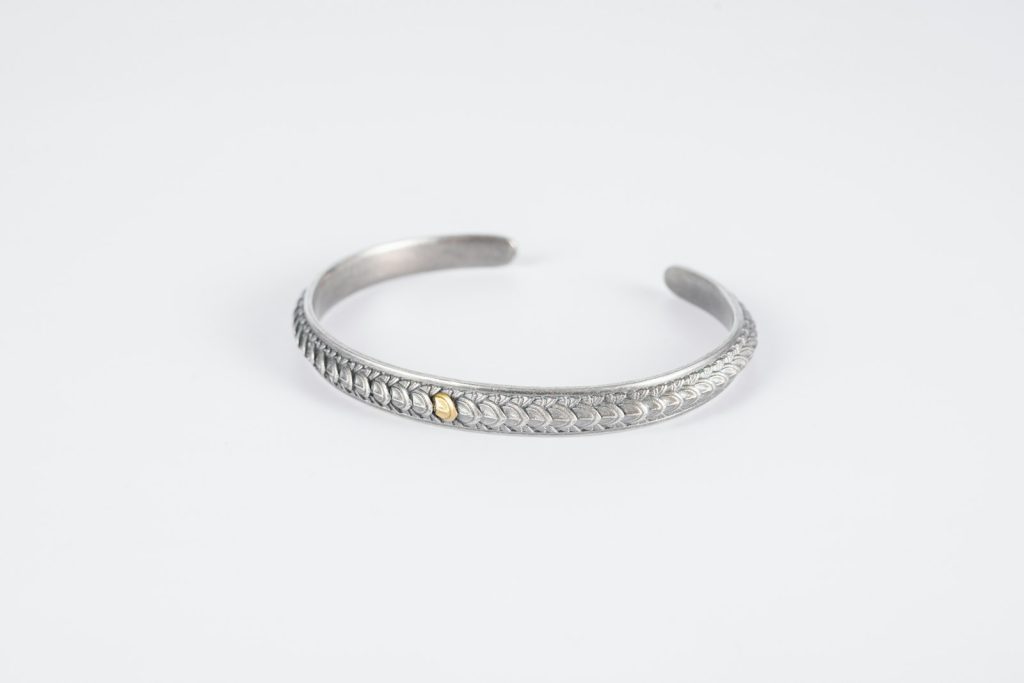
Wholesale silver cuffs are bulk orders of 925 sterling-silver cuff bracelets produced to repeatable specs (design, gram weight, size curve) and shipped under formal Incoterms. For buyers, “wholesale silver cuffs” usually means MOQ-linked unit pricing tied directly to silver gram weight, with clear bands for plain, filigree, stone-set and men’s models.
What Counts as a 925 Sterling Silver Cuff Bracelet?
A cuff bracelet in 925 is a rigid or semi-rigid open bangle made from sterling silver alloyed at 92.5% pure silver and 7.5% copper (or copper-dominant mix). In our Celuk workshop cluster, that means:
– Alloy: 925‰ millesimal fineness, verified by periodic XRF testing and local assay.
– Construction: solid strip, cast base with hand-built filigree, or wire-built structures.
– Shape: usually oval for wrist comfort, with a gap of ~25–35 mm for most adult models.
– Finish: polished, oxidized (blackened recesses), brushed/matte, or rhodium/e-coat treated.
“Sterling” is the alloy specification, not a quality slogan. For import compliance and buyer trust, every cuff leaving Celuk should be:
– Stamped “925” or “STERLING” (or both), plus your brand/maker’s mark if requested.
– Within tolerance on declared gram weight (we work on ±3–5% band, model-dependent).
– Matched to your target size curve (women’s / men’s / unisex).
Main Wholesale Silver Cuff Categories We See Ordered
Across Celuk’s export desks, 925 cuff wholesale orders usually fall into four product families:
1. Plain 925 Silver Cuff Bracelets
These are your “base metal play” pieces: simple, repeatable, price-driven.
Common specs:
– Cross-section: flat strip, half-round, or full round; 3–12 mm width.
– Thickness: 1.2–2.5 mm in most commercial designs.
– Gram weight: ~8–15 g (delicate), 16–25 g (standard), 26–40+ g (heavy).
– Finish: high-polish, satin/brushed, or hammered.
Applications:
– Entry-price anchor in a 925 line.
– Volume seller for general fashion retailers.
– “Canvas” for later engraving/laser branding in your destination market.
2. Balinese Filigree Cuff Bracelets (Handworked)
Balinese cuff bracelet wholesale programs are often filigree-led. Filigree pieces are built from fine silver wires and granules soldered onto a base or constructed fully from wire.
Key traits:
– Hand-built detail: scroll, floral, or geometric motifs.
– Oxidized recesses: deliberate darkening for contrast; not a defect.
– Higher labor minutes per gram: gram cost is only part of the landed price.
Expect:
– Gram weight: 12–30 g for standard women’s cuffs; 25–45 g for statement versions.
– Appearance variation: slight differences cuff-to-cuff are normal for handmade work.
– Slightly higher MOQ per design vs. plain cuffs, to justify development time.
3. Stone-Set Cuff Bracelets
These combine silver with gemstones or cabochons. From Celuk, common stones include:
– Natural: moonstone, garnet, amethyst, peridot, blue topaz (treated), citrine.
– Organic: shell, mother-of-pearl.
– Engineered: cubic zirconia, synthetic corundum/spinel.
Consider:
– Setting type: bezel (secure, classic), prong (more exposure), flush (simple).
– Stone procurement: your stones, our stones, or mixed (OEM).
– QC complexity: symmetry, stone matching, and setting tightness add inspection points.
These run heavier per unit because of the silver required to safely hold stones.
4. Men’s & Unisex Cuff Bracelets
Men’s cuffs trend toward:
– Wider profiles: 8–18 mm.
– Thicker stock: 2.0–3.5 mm.
– Minimalist designs, or bold granulation/tribal motifs.
Gram weight is often 25–60 g, making silver cost the dominant component in the FOB. These products are sensitive to size curves and wrist fit; returns in retail often trace back to sizing, not metal quality.
How Gram Weight Drives Silver Cuff Pricing
For trade buyers, 925 cuff wholesale economics start with gram weight + live silver price.
Silver Content, Labor, and Overhead
Your unit price per cuff is broadly:
Unit Material Cost (Silver)
  + Labor (per model complexity & required skill)
  + Overhead (finishing, QA, scrap loss, admin)
  + Margin (workshop + export desk)
= FOB Unit Price
The silver component is:
Gram Weight × (Silver Spot per Gram × Alloy Factor)
The alloy factor bridges pure silver price to 925 alloy plus fabrication costs (melting, rolling, wire, sheet, casting grain), not just raw metal.
Within Celuk’s supplier base (last verified June 2026, internal range data), typical FOB bands we see quoted for volume orders:
– Light plain cuffs (~8–15 g): lower FOB band.
– Mid-weight (~16–25 g): mid FOB band.
– Heavy/men’s (~26–60 g): higher FOB band, often mostly metal cost.
Because international silver prices move, any quoted number needs a time validity window and a written base-price index (e.g., LBMA fix reference). Request this explicitly in your proforma.
Why Heavier Cuffs Don’t Scale Linearly
Double the gram weight rarely equals exactly double the price:
– Some labor is fixed per unit (polishing, final QC).
– Risk and scrap increase with higher-mass pieces.
– Filigree and granulation add labor layers almost independent of base weight.
Expect heavier, detailed cuffs to carry a slight premium per gram relative to simpler light cuffs.
Sizing: Inner Diameter, Gap, and Fit Curves
For repeat wholesale silver cuffs, define sizing clearly before sampling. Typical adult cuff specs:
– Women’s / standard:
– Inner width: ~58–60 mm.
– Inner height: ~46–48 mm (oval).
– Gap: ~30 mm (±3 mm).
– Men’s / large:
– Inner width: ~62–65 mm.
– Inner height: ~50–52 mm.
– Gap: 30–35 mm.
Key points:
– Always specify whether measurements are taken on the inside of the cuff.
– State if you want oval or round profile.
– Decide whether the cuff can be gently adjusted or must remain rigid.
– Keep size curves consistent across a collection so your retail sizing charts are simple.
For private-label programs, locking a standard S/M/L spec and documenting it in a shared spec sheet prevents confusion between sampling rounds and repeat orders.
Finishing, Oxidation, and 925 Quality Mechanics
Balinese cuffs are known for contrast: bright silver highlights against dark recesses.
Deliberate Oxidation vs. Defects
Intentional:
– Blackened or dark grey areas in recessed filigree, pattern lines, or stamped textures.
– Even, intentional darkening used to emphasize pattern.
Defective / QC-reject indicators:
– Random yellowish/brown stains (flux residue, polishing compound).
– Pitting on high-polish areas visible at normal viewing distance.
– Rough edges where the cuff meets skin.
Your QC checklist should distinguish artistic oxidation from tarnish or contamination. In Celuk, we routinely:
– Specify “oxidized finish” in POs if you want contrast.
– Default to bright polish for plain cuffs unless otherwise stated.
Anti-Tarnish Coatings, E-Coat, and Rhodium
Sterling silver will tarnish in air, especially in humid and sulfur-rich environments. To slow this:
– Clear e-coating (nano/epoxy-based)
– Pros: slows tarnish, especially for high-volume fashion ranges.
– Cons: can subtly change tactile feel; not ideal for heavy patina lovers.
– Rhodium plating
– Pros: bright white finish, strong anti-tarnish; common in higher-end ranges.
– Cons: extra cost per gram surface area; replating needed over years of wear.
For wholesale silver cuffs, coating choice should be consistent across a line. Mixing raw and coated 925 in the same program can confuse end buyers once pieces age differently on the shelf.
925 Marking and Compliance
Core requirements for export-ready cuffs:
– 925 stamp on an inconspicuous area (inside of cuff, near one end).
– Optional: your logo or hallmark, subject to local laws in destination markets.
– Country-of-origin marking if required by your import jurisdiction.
Ask your supplier for:
– Clear photos of the marks on PP (pre-production) samples.
– Alloy test method and frequency (XRF, spot checks per batch).
MOQ Bands and FOB Structures for 925 Cuff Wholesale
Wholesale cuffs are normally offered on MOQ tiers. Exact numbers vary by workshop and design complexity, but operationally, we see:
– Development MOQ (sample stage):
– 1–5 pcs per design, at sample surcharge or non-discounted unit price.
– First production MOQ:
– Plain cuffs: usually lower piece count per design.
– Filigree/stone-set: higher minimum per design to cover setup.
– Ongoing reorder MOQ:
– Often negotiable if total order value meets a threshold across multiple SKUs.
On pricing terms:
– Most Celuk-based makers quote FOB Denpasar (Bali) or FOB Surabaya/Soekarno-Hatta via forwarder, depending on cargo routing.
– Payment terms are usually:
– 30–50% deposit on PO confirmation.
– Balance before shipment, post-QC approval (photos or third-party inspection).
Clarify:
– Whether prices are locked to a silver base price and adjusted per order window.
– How often price lists are updated when silver moves significantly.
– What counts as “one design” (stone color changes; small size variations; finish changes).
Comparing Cuff Types at a Glance
| Type | Typical Gram Range* | Complexity | MOQ Tendency | Best Use Case |
|---|---|---|---|---|
| Plain 925 cuff | 8–25 g | Low | Lower | Entry-price, volume retail, personalization base |
| Filigree Balinese cuff | 12–45 g | High (handwork) | Medium–High | Brand-differentiating artisan range |
| Stone-set cuff | 15–50 g | Medium–High | Medium | Gemstone-led collections, giftable pieces |
| Men’s / heavy cuff | 25–60 g | Low–Medium | Medium | Men’s lines, premium statement ranges |
*Gram ranges are indicative bands from Celuk workshop programs and not a quotation.
To map these options to your assortment, we generally walk buyers through a structured spec sheet. If you’re building a collection and need help aligning design, gram weight and FOB targets, you can request a wholesale quote or schedule a WhatsApp call with our desk for a detailed costing walkthrough.
OEM and Private-Label 925 Cuff Programs
Celuk is effectively a cluster of specialist workshops. For cuffs, common OEM/private-label pathways:
Using Our House Designs
– You select from existing cuff molds and models (plain, filigree, stone-set).
– Options:
– Slight dimensional tweaks (width, thickness, length).
– Finish choices: bright, oxidized, brushed, partial oxidization.
– Branding stamp inside cuff if tooling allows.
Pros: faster sampling, no mold fee for many models, proven manufacturability.
Cons: not fully exclusive; other buyers may run similar silhouettes.
Custom Designs from Your Sketch or CAD
Workflow typically:
1. Design review (feasibility vs. 925 strength, thickness, and wearable comfort).
2. CAD or technical drawing iteration.
3. Master creation (hand or CNC).
4. Sample casting and finishing.
5. Wear test and QC sign-off.
6. Production under agreed MOQ.
You should expect:
– Development fees for complex masters.
– At least one iteration round based on your feedback (“too heavy”, “gap too wide”, etc.).
– Clear IP/ownership terms for the master and CAD, agreed in writing.
Branding, Packaging, and Barcodes
For trade buyers moving beyond loose bulk:
– Stamping: your logo or hallmark inside the cuff.
– Packaging:
– Bulk polybags per unit.
– Branded boxes/sleeves (you provide design and dielines).
– Labeling:
– Country-of-origin tag.
– Care instructions (“925 sterling silver, avoid harsh chemicals,” etc.).
– Optional barcode labels aligned with your POS system.
Not every Celuk workshop handles full packaging; often the export desk coordinates separate packers. Confirm who is responsible for which component and at which FOB location.
Quality Control: What We Check on Silver Cuff Bracelets
For each batch, a structured QC protocol saves rework, dispute, and long-distance friction.
Typical QC checklist for cuffs includes:
– Alloy confirmation:
– Periodic XRF spot tests on random units per lot.
– Gram weight:
– Sampling by model, verifying within your agreed tolerance band.
– Dimensioning:
– Inner width/height and gap on a sample set.
– Cross-check that size labeling (S/M/L) matches physical difference.
– Finish:
– Uniform polishing, no deep scratches.
– Even oxidation where requested.
– Clean edges at ends of cuff (touch test for sharpness).
– Structural integrity:
– No visible cracks at bends.
– Flexibility in “slightly adjustable” designs without immediate deformation.
– Stones (if present):
– Stone presence and count per design.
– Tightness of settings (no visible wobble).
– Basic visual match on color/clarity for natural stones.
For larger orders, many importers also send independent inspectors. We work with that model regularly and can align on inspection checklists and AQL levels.
Practical Tips for New Buyers of Wholesale Silver Cuffs
1. Always Tie Specs to Numbers
Avoid vague instructions like “solid feel” or “not too thin.” Instead:
– State target gram weight range per piece.
– Define minimum thickness (e.g., “not less than 1.5 mm at thinnest point”).
– Provide reference photos with notes.
2. Anchor Prices to a Silver Benchmark
Ask suppliers to:
– Quote at a specific silver base price (date and index).
– Define adjustment rules if silver moves beyond a threshold before production.
This avoids surprise re-quotes and keeps both sides aligned.
3. Sample in Real Wrist Sizes
Order samples in the full intended size curve:
– S, M, L (or women’s/men’s/unisex) as relevant.
– Have multiple colleagues try the cuffs and collect feedback on comfort and gap.
Adjust before locking tooling; altering size curves later usually means reworking masters or bending stock in ways that compromise finish.
4. Separate Aesthetic from Defect in Your QC Feedback
Clearly label observations:
– “Design/Style change request” (e.g., “less oxidation,” “narrower band”).
– “Defect” (e.g., “visible solder line,” “stone loose”).
This keeps discussions with workshops more productive and avoids mixing preference with non-compliance.
Working with Celuk Silver Wholesale on Cuff Bracelets
Celuk Silver Wholesale acts as an independent 925 sourcing and export desk in the Celuk/Bali ecosystem:
– We match you with appropriate cuff-capable workshops (plain, filigree, stone-set, men’s).
– We coordinate sampling, Gram + QC checks, and export handling.
– No one can pay to change what we publish; if you proceed with our partner they may pay us a referral fee at no extra cost to you.
If you’re building or expanding a wholesale silver cuff line and need hard numbers — gram weights per design, indicative FOB bands, and QC plans — you can request a wholesale quote or open a WhatsApp planning thread with our team to review your brief and timeline.
FAQs: Wholesale Silver Cuff Bracelets
How many grams should a quality 925 cuff weigh?
For mainstream retail, most women’s cuffs run ~12–25 g and men’s ~25–50 g. Below ~8–10 g for a full-size cuff, durability and feel often suffer; above 40–50 g you are in premium/statement territory where metal cost rises quickly. Always align weight with your target price point and brand positioning.
Are Balinese oxidized cuffs really 925, even though they look dark?
Yes, if correctly made. The dark areas are usually deliberate oxidation in recessed parts of a 925 cuff to emphasize detail, especially in filigree and granulation. The raised surfaces are polished bright. You should still verify 925 markings and request alloy testing from your supplier, but blackening alone is not a sign of lower purity.
Can I order the same cuff with and without stones from the same supplier?
Typically yes. Many Celuk workshops can run a plain 925 base cuff and a stone-set variant. Expect separate MOQs and slightly different gram weights and FOB bands. Clarify whether they treat these as different SKUs in their costing and what happens if you split volume between variants.
Should I specify rhodium plating on wholesale silver cuffs?
Specify rhodium if your market expects a bright, low-tarnish finish and you are positioned mid–high. It adds cost but improves shelf life. For artisan, oxidized, or Boho collections, many buyers skip rhodium and either use clear e-coat or leave silver raw, accepting some tarnish over time as part of the look.
What Incoterms are common for 925 cuff wholesale from Indonesia?
Most Celuk suppliers quote FOB via Indonesian airports or ports, with some able to quote FCA or EXW for buyers using their own logistics networks. Clarify the named place (e.g., airport city) and who handles export clearance. For first orders, many importers prefer FOB to keep responsibilities clear.